Tuesday, 12 August 2014

Tragedy and Comedy

I don't usually feel deeply affected by the news of the passing of celebrities or other public figures. When the news pops up on Facebook - which is where I usually first come across it - I might feel, if I enjoyed their work, regretful that they will produce no more. Often, especially if I didn't have any great interest in them in life, any emotion I will have will be for their families; when Peaches Geldof died, it was Bob Geldof's simple, wrenching statement that "We are beyond pain" that gave me pause. But I often feel awkward at the idea of public grief for a complete stranger. I think this dates back to when my beloved Nana died in very close proximity to the Queen Mother. Young as I was, I vividly recall feeling almost angry at the tears shed on television for the Queen Mum by people who had never known her, barely days apart from my shedding my own tears at the funeral of a grandmother I knew and loved.

But this morning, I woke up to the news of the death of Robin Williams, and, for the first time at the death of a celebrity I never knew, I feel genuinely floored. I must have watched Mrs Doubtfire a dozen times over my childhood. One Christmas, I think, my family watched and recorded Hook, but then someone went and recorded over the first hour or so of the film. But the second half of that film I also watched over and over again. I remember both films arousing deep feelings in me. They were both, of course, exceedingly funny, but they both invoke great pathos - for example in the shuddering, humiliating moment in which 'Mrs Doubtfire' is unmasked, and in the sheer idea of Peter Pan as an adult grown. I noticed a comment on Facebook this morning which said that Williams' films would always be tinged with sadness from now on. But, I think they always were. But comedy tinged with sadness is true to life, and therefore a very special thing. And I feel real sadness that a man who touched on that truth is gone.

And then there is the manner of his passing. According to news reports nothing is confirmed, but it seems likely that his death was suicide. I have felt... oddly pleased, though that is not the right word, to see many people saying that he "died of depression". To me that seems a far more accurate, and empathetic, description of a life ended in the throes of depression. It was not so long ago that Christians who committed suicide were denied burial in holy ground for the blasphemy of taking a God-give life. But to speak of someone dying of depression is to express an understanding that they suffered from, and succumbed to, a terrible illness, even if it was not one of the flesh. There should be no more blame, and no less sympathy, attached to that person than there should be to someone who died of a physical illness.

But, there is blame somewhere. I feel so confused and angry that a man with wealth and fame and a loving family still died of depression, still could not be saved from his illness. I think of Robin Williams and I think of the people I know who suffer from the same illness, and I want to know where they would get help if they truly needed it. I feel angry that society is still only slowly moving towards an appreciation of mental illness as a genuine, often treatable affliction, and not something to be ashamed of, to not ask help for if you suffer from it. And I feel angry with depression, for the strength it has and the destruction it wields. Perhaps all the public understanding of mental illness in the world could not save some sufferers from dying of it.

So, for the first time ever, I have cried to hear of the death of a celebrity who I never knew, apart from through his comedy. 
The thought that a person who, indirectly, made my childhood self laugh and stop and think is gone is bad enough. But the thought that such a person died of an illness that left him with so little joy, and so little compassion for himself that there was only one thing he could do to escape it... that is what makes me cry. 

---------------------------------------------------------------------------------------------

A Postscript.

As I hope this essay expresses, everyone needs help sometimes, and there is no shame at all in that. Call a friend, call a family member, call the Samaritans (08457 909090). Do not suffer in silence. 

Sunday, 19 January 2014

The sea, the sea

St Andrews Cathedral, with Rule's Tower in the
foreground.

My first thought for an opening sentence for this blog post was "there are many consolations for living and studying where I do", but on reflection that struck me as being rather more negative than I intended. I think I am happier, both domestically and academically, living in Crail and studying in St Andrews than I ever have been before. So perhaps I shall say instead, there are some unexpected moments that provide sudden and lovely illumination to a daily life that is already pretty contended.

Mr S and I experienced one such moment a few days ago, whilst at a loose end due to the later-than-usual opening of the university library that day. Fortunately, St Andrews is a pretty lovely place to wander around - I could probably spend hours wending through the gravestones in the old cathedral site, absorbing hundreds of long-gone names, all in the skeletal shadow of the ruins that provide the archetypal image of the St Andrews skyline. That day, however, we decided to wander down past the castle to watch the waves rolling in on the (imaginatively-named) Castle Sands. However, the sight of a great flurry of waves breaking on the pier down by East Sands drew us further along the coastline, and down onto that narrow stone spur, which at high tide on a blustery day looked almost impossibly fragile against the great weight of the sea.

We just stood and watched. We didn't venture too far out - unlike the people standing at the very end of the pier, we were none to keen to experience the sensation of the sea dumping an entire wave's-worth of water upon our heads, as it did repeatedly during the time we watched. The waves crashing against the terminus of the pier seemed to almost fling themselves up its sides, creating a great plume of water which was then caught by the wind, fully dowsing the outcrop and any foolish enough to stand upon it. Even the point at which we had planted ourselves, barely a third of the way along the pier, seemed to affront the waves so much that every fourth or fifth surge made a valiant attempt to reach us, with water roaring up and onto the pier-top a metre further down the narrow way.

Looking towards St Andrews Castle. I didn't even try to capture
the sensation of looking out from the pier - concerns about the
bad combination of water and technology aside.
Although occasionally distracted by the rushing water that seemed so keen to make our close acquaintance, we spent most of the time gazing further out to sea, watching the hypnotic movement of the water, as smooth, concave rifts grew higher and higher - quite incredibly high - until they broke into a frothing and raging crest. And then there were the cross-currents, as waves which redounded against the pier surged back to meet their fellows at right angles, causing mountains of spray to fly up where they collided with one another. And then there was the noise - booming, crashing, whooshing. It was like watching fireworks as a very small child: every huge wave was a new surprise, every plume against the pier a reason to exclaim in sheer joyful surprise.

One of the concepts which I know I'm going to have to confront and analyse in my work on early modern reactions to mountains is that of 'the Sublime' - the idea that there is a certain type of aesthetic response to certain aspects of nature, in which the sight of something great but slightly terrifying or horrifying inspires a type of overwhelming awe. I have problems with the idea of using the category to judge past reactions to nature, but I'm also not sure I could find another word to describe the feeling of standing, tremulous and fixed, upon a man-made outcrop of rock, and staring out at a display of the roiling power and energy of the sea. It was frightening - every one of those waves would have swallowed me whole had I been standing beneath them - but also thrilling, and joy-inspiring. It was, in a word, sublime.

Being a PhD student can, I am told, sometimes be a hard slog. I am fortunate that I have not yet encountered the moment in my research where I feel that sheer exhaustion with my own topic and research. But, when I do, I will try to remember to prescribe myself a moment or two upon the pier, on a wild and windy day, breathing in the breath-taking. Because there is something about the sublime that energises the spirit. 

Friday, 8 November 2013

Coming out of my wardrobe

This is a post that has been rattling around at the back of my mind for months, but it wasn't until I watched the video below that I was finally able to get together the guts necessary to write it. I would really, strongly recommend watching it if you can spare the time - it's a wonderful and sympathetic take on something that, as the speaker points out, affects almost everyone - even if in different ways.


So, I'm coming out of my 'closet'. It is not, as Ash Beckham puts it, a rainbow-coloured one, and as I think it has certain fairly British qualities, I'm going to call it a wardrobe. My wardrobe has the picture of a massive black dog painted on the front of it. I never know quite the right verb to use. I have? I experience? I suffer from? I live with? Whatever the verb, the noun is simple: depression.

I'm not going to write today at any length about how I experience - or deal with - depression, but rather want to discuss why not talking about it became a 'wardrobe' in the first place.

To some extent, I guess it's cultural, in two directions. Internally, I suspect I have a certain amount of the British stiff-upper-lip - or at least the British mental cringe at the thought of doing anything so forward as to declare my emotions publicly, or to bother anyone else with the fact that I'm experiencing difficulties with them. Externally, there's a perception I have that people in general might not be sympathetic to 'confessions' of depression; that there might still be people out there who think I'm just being pathetic, need to get over myself, or am even just making it up to get attention. 

Of course, this perception of an external negative attitude towards depression may also be a symptom of depression. Something that I have increasingly come to realise over the past few years is that, from my point of view at least, depression is a remarkably self-preserving illness. It doesn't want to be found out. Obviously this is a ridiculous statement on some levels - my depression does not, of course, have mental autonomy to scheme against me - but I think it holds a grain of truth. Depression often brings with it strong feelings of worthlessness and shame. If you feel worthless, why should you seek help? Only people with 'worth' deserve aid or care. And if you feel ashamed, why should you speak out - afraid as you are of being judged for what you admit?

And that is why I am writing this post. I am having a good stretch of days in the midst of a bad patch and I'm feeling ready to start trying to train that bloody dog. The lessons might not stick, of course - another truism I'm coming to learn about having depression is that expecting a one-time 'cure' may not necessarily be the best way to think about it - but at least it might retain the memory of them next time it comes back, and be more promptly quietened. So, I am coming out of my wardrobe, and speaking out. Because I am worth something, and having depression is nothing to be ashamed of.

Don't be afraid to step out of your closet, whether you have to fight through prejudice or, perhaps, the metaphorical Hound of the Baskervilles in order to put your hand against the door. It - and you - are always worth it.

Wednesday, 6 November 2013

Because a thesis just wasn't enough...

This year, for the first time, I am taking part in something that I have long been tempted by: I am 'doing' NaNoWriMo 2013. NaNoWriMo, if you haven't heard of it, stands for 'National Novel Writing Month', i.e. November, during which participants are encouraged to write a novel of 50,000 words or more. 

As this blog might imply, I truly enjoy writing, and I've felt a little sad over the last few years that I haven't invested much time in writing fiction, which is really where a love of writing all started for me. When I was sixteen I wrote and quite literally 'self-published' - i.e. printed out and bound up using an industrial stapler - a novel about the stone gargoyles and stained-glass angels of a village church coming to life on Midsummer's Eve, and sold it to friends, family, teachers, and anyone else who could be guilt-tripped into paying £3.50 for it in order to raise funds for a trip to China. I even sent it off, unsolicited, to a number of publishers, resulting in a cherished sheath of rejection letters.

So, this year I decided that this would be the year I finally did NaNoWriMo. To my pleasant surprise, when I mentioned this to Mr S he said that he had been thinking the exact same thing, so we're currently doing it together and cheer-leading / guilt-tripping one another on.

I am having a massive amount of fun. Perhaps out of an unconscious desire for an antithesis to the planning-heavy early days of the PhD, my brain produced an excellent premise for a novel on the night of October 31st, so rather than writing up any of my ready-plotted ideas I found myself leaping straight in on November 1st with absolutely no idea of where I was headed. I am now 12,839 words in and have only a hazy idea of what the next chapter will contain. Don't even ask me about an ending. But, instead of sleeping in for an extra half an hour in the morning, or falling asleep in front of yet another xojane article at the end of the day, I'm writing and disappearing into this whole fictional world.

It's also, ironically, making me both more productive in my academic work, and helping me to feel less stressed about the PhD. Mr S and I have got into the habit of trying to write half our daily 'quota' (you have to write at least 1666 words a day - plus an extra 20 at the end! - to get to 50,000) first thing in the morning, and it certainly wakes you up. The feeling of achievement of bashing out 1000 words before breakfast also certainly helps to keep up morale when turning to read Foucault (don't ask). And as for stress, well, let's just say that after writing 12,000 words in six days, writing 80,000 words over three years doesn't seem quite so bad. Obviously there's a lot more to a PhD than just writing by the skin of one's teeth, as I am with NaNoWriMo, but I also feel much happier about my initial plan of front-loading my research and having a real 'writing up' period in my last year (a tactic that is more unusual in the humanities than in the sciences, I think).

Is there anyone else out there doing NaNoWriMo? How are you finding it?

Next time... if I work up the courage, I might give you a synopsis of my novel, or at least the fifth of it that I've written so far!

Saturday, 26 October 2013

Once Upon a Time on the Internet...

Last night, after a glass or two of wine, and via a facebook link, I ended up reading College Humour's (extremely funny, but rather Western-centric) 'Facebook History of the World'. I had read bits of pieces of it before, but never all the way through, and I blinked a bit at this one:


I blinked because it's a little disconcerting to suddenly realise that your mind contains the memory of something so trivial. I remember - just - the days when the internet quite literally came on a CD. And it got me thinking about how much the internet has changed even within my lifetime. It struck me that one of the weirdest things is not how much the internet has developed, but how much I, at least, take the current status quo for granted. I haven't thought about my childhood experience of the internet for, quite literally, years.

I know that I can't exactly claim to have any memories of the 'birth' of the internet as a technology, but I think I certainly fall into the age bracket of people who were children when personal computing and using the internet started to become more and more common within the home. I remember my family's first computer - I think for some reason I called it 'Sally' - with its screen that was massive not in width but in depth - and the excitement in discovering that, unlike my grandfather's slightly older computer, it showed colours that were not black and green. And dial-up internet! Just listen to this sound clip. Doesn't that take you back? It's hard to imagine that eight-year-old me happily waited up to a minute or two just to get onto the internet, when twenty-two-year-old me gets antsy when Gmail takes more than 5 seconds to refresh -heck, when a large PDF document takes more than ten seconds to download!

And then there was the fact that, in the first few years at least, my parents had the type of internet that you paid for by the minute. I seem to recall that they agreed a tariff with me and my brothers whereby we would pay a certain contribution to the cost of the internet per minute (I think it was maybe 2p per minute?). Speaking of childhood memories, does anyone remember the Wonka chocolate bars and sweets that were around in the late 90's? Gobstoppers and chocolate bars with crackling candy in the middle? I think the packets advertised a website that had games on it, and I would save my pocket money to spend ten or fifteen minutes playing games on that site. I don't think I was really aware that the internet contained anything else.

It's very strange to think that a technology that seemed, at the time, a bit slow and a bit silly is now such a large part of my daily life. I backup my work to 'the cloud', I write blog posts in my browser, I stay in touch with friends and family via email, and so on. It's pretty rare that I ever happily 'work offline'. (Ah! Another memory: the good old days when webpages contained so little information that your computer would 'save' the pages you'd loaded automatically and you could look at them again without being connected).

However, if it's strange to think that technology we now take so much for granted was - so recently - just a fifteen-minute game when we were children, it's even stranger to realise that, 'even' today, the majority of the world is not on the internet. Obviously, some might argue that other more basic problems, such as world hunger and disease, need to be dealt with before we start worrying about digital equality. But perhaps it's striking to realise that, for all the talk of this being a 'digital age', accessing the internet - be it in ancient dial-up form or through high-speed broadband - is still a privilege. And perhaps that, just as much as amusing childhood memories of AOL cd's, should remind us not to take it for granted.

Monday, 30 September 2013

Battlestar Galactica: A Spoiler-Free Recommendation

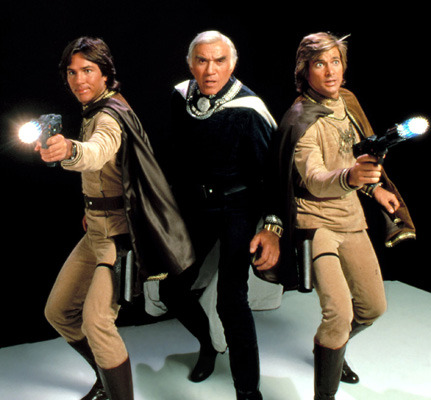
Mr S and I both share slightly obsessive-compulsive tendencies when it comes to watching television. When we come across something we like, we watch it to the exclusion of anything else, with sessions of two or three episodes once or twice a week (we are also impatient, and prefer to leave the minimum amount of time between cliffhangers) until we have exhausted the entire series. This is probably one of the reasons why we don't have a TV, but we do have a Netflix subscription. Our latest addiction has been to Battlestar Galactica - not the one from the 1970's with the wonderful and ridiculous 1970's costumes, but the 2003-2009 remake.
Capes just seem a bit impractical for space fights.
I first came to science-fiction television through Star Trek, by which I mean I was pretty much raised on a steady diet of Next Generation, followed by Deep Space Nine, followed by Voyager, and rounded off by Enterprise which, due to coming out when I was in my early teens and starring several wonderfully chiselled jaws, ended up being the focus of my earliest fantasy 'crushes'. So the Star Trek universe has always been something of a ballpark against which I measure other science fiction. To be honest, this does not exactly disadvantage the rest of the genre.

One of the things which both makes Star Trek compelling watching and yet also removes its potential to really sting its viewers into sitting up straight with excitement is, well, its morality. Gene Roddenberry, its creator, wanted to portray an optimistic - some might say, idealistic - vision of the future. Conflict within episodes was to come from external sources, rather than occurring between characters, as he believed that 'by the 24th century, humanity had transcended petty conflict, and... arguments in the same way it had gone beyond poverty and disease and wars'.[1] These rules were not, of course, always strictly followed throughout different incarnations of the show (part of the drama of Voyager, of course, came from the potential for internal disagreements between a group of people stuck on a ship decades away from home), but the basic message underlying most of Star Trek is: humans are okay, really, and things will come right in the end. 

Which is why it is sometimes refreshing to encounter science fiction that takes a slightly less rosy view of things. Hence my enjoyment of the new Battlestar Galactica. To call the show 'dark' would perhaps be a mild understatement. I don't think it would be spoiling anything for those who have never seen the show to say that the first episode starts by almost all of humanity being wiped out in a nuclear attack by 'the Cylons' upon the Twelve Colonies, given that this is the basic premise of the show and is noted in the first sentence of pretty much any online synopsis you'll find. But anyway: it's stark. And the writers give some much harsher answers than Gene Roddenberry would have done to the question of what would happen to a group of 50,000 humans stuck in cramped conditions on a group of surviving ships as they run for their livesThey bicker. They riot. They complain about food rations. They sleep with people they shouldn't sleep with. They make really, really bad calls.

Especially this character. She had me shouting at the
screen in sheer exasperation a few times.
Like most successful science-fiction shows (and I use 'successful' in the sense of 'had a full run of seasons', unlike, sniff, Firefly), Battlestar Galactica has left fans and critics deeply divided. One blogger, following up on a post and epic comment thread which lasted approximately 4 years (!), concluded that he would recommend the show to a friend, but with serious reservations. This conclusion was largely due to the finale, which did, admittedly, contain some plot holes big enough to manoeuvre a battlestar through.[2] My own take on it is that the finale was, at the very least, more emotionally satisfying than many a finale, and that an entire series should certainly not be judged on the basis of its last three episodes.

So, the question for me is not so much would I recommend BG (as Mr S and I got to affectionately calling it) to a friend, but why would I recommend it. As I hinted at above, the conflicts and issues raised by the premise of a near-extinct human race fleeing from their enemies are fascinating. Issues of how justice, democracy, and social mobility would work within such a limited and, let's face it, terrified population are all considered and, I think, dealt with in a realistic and compelling fashion. Then there's the question of the Cylons. The Cylons were created by man, and the destruction of the Twelve Colonies is their revenge for what they see as their previous enslavement. Throughout the show, the question of what constitutes humanity is asked. If the Cylons can feel love, grief, and pain, are they human, or at the very least deserving of humane treatment? However, what really makes the show are the characters, and the actors who portray them. You might despise some of them at times, but they are all of them believable and complex, from the strict, gruff, angry but ultimately warm-hearted Commander Adama, to the crazy-I-really-want-to-have-abs-like-hers Kara 'Starbuck' Thrace.[3] You really want them all to survive and, in a show in which survival is constantly at question, it's that desire that keeps you coming back week after week - or, in our case, letting Netflix tick onto the next episode, and the next, and the next...

I could go on more, but instead I'll just say: if you enjoy science-fiction, and enjoy television that makes you think (and occasionally shout at the screen), you should give Battlestar Galactica a go.[4] Regardless of the ending, and perhaps appropriately enough for a show which is essentially about getting from point A to point B, the journey is entirely worth it.

Also, I love the design of the Galactica (the eponymous
main ship). It's hulking and huge and seems kind of like a
comforting old dog.


[2] Initial post here, reluctant recommendation here. Spoiler warning!
[3] Starbuck was a man in the original. The actor who portrayed him wrote a protest against the 'castration' of his character which I think does more to indict him than it does the choices of the directors of the remake. 
[4] If you’re a newcomer to BG, you have the advantage of everything – interim webisodes etc – available to watch in the best possible order. This guide might be handy, though I wouldn’t agree with his suggestion of leaving any episodes out! 

Thursday, 19 September 2013

Why I am Voting Yes, Part I - Political Autonomy

I have felt somewhat nervous in preparing for, writing, and publishing this post. I do not enjoy confrontation, and unless an issue is something I really care about, I try to avoid bringing up topics that may cause contention between myself and another, be they my friends, acquaintances, or complete strangers on the internet. Unfortunately, I find myself caring more and more about contentious issues as I grow up (a process which I’m sure I haven’t finished with yet!). Scottish independence is one such issue, and one that I have been putting more and more thought into lately, not least – but also not solely – because I have recently moved to Scotland, and will be voting in the referendum in September 2014.

I will be voting “yes” when I go to the polling booth.

As indicated above, admitting this in such a public forum – especially one which I believe many friends, some of whom have equally strong feelings in the opposite direction, read – took a certain amount of screwing my courage to the sticking place.[1] A few days ago I went onto the “Yes Scotland” website and signed their online declaration. But such gestures are fairly meaningless if I carry them out quietly and privately at my own desk – hence this post.

Why will I be voting “yes”? There are a plethora of reasons, reasons which are often batted away all too easily when they are given together and in summary. For that reason, I intend to discuss each reason in a separate blog post. However, the one I want to start with is the issue of political autonomy, and I want to justify my sense in the importance of this by looking at a few maps and statistics.


Above are two maps, one from the 2010 general election, and another from the 2005 general election. (As an aside, I find it a surprise looking back how geriatric the 2005 map seems, and how recently this sort of graphical take on reporting election results seems to have been in vogue!) In terms of the four colours filling Scotland, red is Labour, blue is Conservative, dark yellow Liberal Democrats, and light yellow SNP. I chose these maps because they make it really visually striking how distinct Scottish voting patterns in 2005 and 2010 were from the rest of the UK, mainly England (although the size of the constituencies farther north obfuscates the Liberal / Labour divide – Labour won 45 seats in both 2010 and 2005, and the Liberal Democrats 11). Of the 307 seats won by the Conservative Party in 2010, one was from Scotland.

This political distinctiveness from the rest of the UK is nothing new. Pushing further back into voting history (and relying now, alas, on statistical tables rather than online interactive maps!), Scotland has never had more than one Conservative seat since 1997, in which year they lost the 11 seats they had won in 1992, leaving them with a grand total of 0 seats in Scotland for the duration of Tony Blair’s first government. Under the aegis of Margaret Thatcher, from the 1979 to the 1987 election, the Conservative Party did rather better, with a high of 22 seats (and 31.4% of the overall vote) in 1979, and a respectable low of 10 seats (and 24% of the overall vote) in 1987. However, during that same period, Labour saw a high of 50 in terms of seats (and 39% of the overall vote) in 1987, and a high of 41.6% of the overall vote (and 44 seats) in 1979. They never won less than the 41 seats, just under half of the Conservative total for the same year, filled in 1983. Only once since the end of the Second World War have the Conservatives gained more seats in Scotland than Labour – that was in 1955, when 36 seats went blue and 34 went red.[2]

This post is not about the pros and cons of specific party politics per se. However, a friend of mine has a comment that he makes from time to time regarding the current political establishment; “David Cameron, you won a minority government. You did not receive a mandate to rule.” And yet, in spite of that lack of mandate, the government since 2010 has brought into effect a variety of significant policies, some of which, it could be argued, reflect Conservative ideals far more than those of the Liberal Democrats (for example privatisation of public institutions such as the NHS and Royal Mail, and increasing student fees, to name but a few). In other words, these policies represent the voices of a minority of voters within the UK. Such a reflection is even starker when considering Scotland alone. In 2010, whilst 39.6% of voters in England put a tick next to the blue box, only 16.7% did the same in Scotland (I fear my mathematical skills are not up to figuring out the overall proportion for the ‘rump United Kingdom’).[3]

What this adds up to is simple: the political views of the majority of people in Scotland are not represented by the Parliament in Westminster.

I am aware of the existence of the Scottish Parliament: however, it does not currently have the power to make the same kinds of life-changing decisions that Westminster makes every day for the population of the UK. To highlight one (less hotly discussed) such element of governmental policy, there have been suggestions that Scotland would be better off with a different immigration policy than England; Scotland is under-populated, and relies on migration for population growth far more than the rest of the UK does.[4] Moreover, it seems that the people of Scotland on the whole have a less negative attitude towards immigration than those in England.[5] Michael Moore, the Secretary of State for Scotland, has argued that Scotland changing its immigration policies after potential independence would cause a “complete nightmare” in terms of Scottish-English border controls, suggesting that, in spite of the arguments against a “one-fits-all” approach to immigration, this is one area in which a non-independent Scotland would be highly unlikely to see any autonomy.[6] And this is just a single issue. And is it really likely that the vast majority of voters in Scotland who have, over the past fifty plus years, voted for left-wing parties, have ever desired the policies brought in by successive right-wing governments ruling from Westminster?

Therefore, one of the reasons I am voting “yes” is because I strongly believe that the gap between Scotland and the rest of the UK is far more than a historic line on a map. There is a clear disparity between the decades-long political allegiances of the Scottish population, and the rest of the Union. This is not about high-sounding phrases such as “Scotland should rule itself”, or “Scotland’s voice should be heard”, but the political reality for a population of over 5 million people inhabiting a country that is not just geographically but politically discrete. Scottish voters should be able to look at the government making the policies that shape their lives and know that they reflect their democratic voices, as 30 years out of the past 54 have not.

***

Postscript: I am aware that one possible response to this argument is that political distinctiveness should not political independence make, otherwise one could argue for the total independence of certain counties within the UK which have traditionally voted in a certain way. It is difficult to know how to respond to this (although I think it is perhaps a shade reductio ad absurdum), except to repeat that this is but one of my reasons for supporting the dissolution of the Union, and that this reason is by no means independent of the others that I have yet to discuss. The "line on the map" between Scotland and the rest of the UK is evident in other ways, and it is when all of these differences - political, social, cultural - are taken together that I, personally, find them persuasive. 


[1] If you are one of those friends, please let me say that regardless of differences in opinion on political matters, I hold you all in great affection. Please keep talking to me! :)

[2] http://en.wikipedia.org/wiki/Elections_in_Scotland#UK_Parliament.2C_Westminster
I refer both to seat totals and percentage of vote to satisfy the interests of both those who support FPTP, and those who prefer the idea of PR voting. I am aware that in PR terms there would be more Conservative seats in Scotland for many of the elections I refer to than occurred with FPTP.

[3] I have no idea how I would even do that without knowing the exact number of people voting in each constituent part of the UK...